

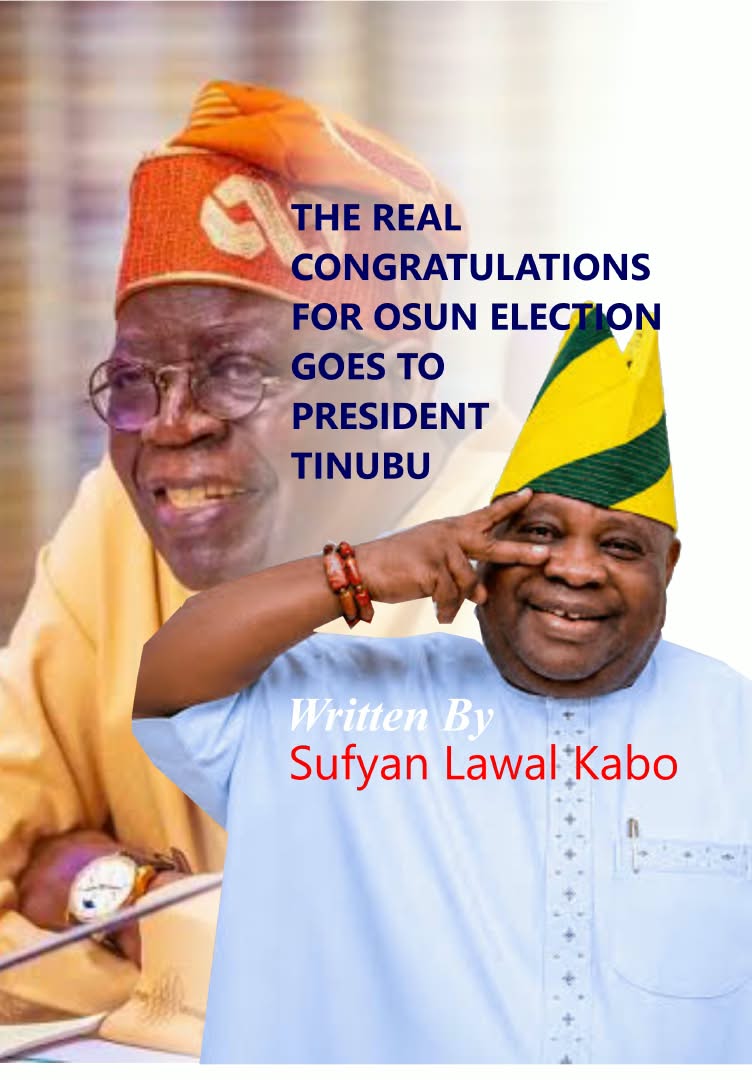
By Sufyan Lawal Kabo
As an APC member, I believe the outcome of the Osun State governorship election should make every genuine democrat pause and reflect. While I congratulate Governor Ademola Adeleke and the people of Osun State, I make bold to say that the bigger congratulatory message goes to President Bola Ahmed Tinubu.
Why? Because APC losing an election under an APC-led Federal Government does not automatically mean democracy has failed; rather, it means democracy has won.
Those mocking APC over Osun and already presenting the result as proof that APC will fail in 2027 are seriously misunderstanding Nigerian politics. An election in one state cannot determine the outcome of a presidential election years from now. Nigerian voters are not permanently owned by political parties. The same voter can support one candidate for governor today and another candidate for president tomorrow.
In fact, Governor Adeleke himself has publicly endorsed President Tinubu for the 2027 presidential election. On June 17, 2026, he described Tinubu as “our son, father and leader” and declared that his support for the President was “unshaken and total.”
This is why I see Osun differently. President Tinubu had the enormous political influence of the Federal Government at his disposal, yet the election was allowed to take its course. The APC went to Osun to campaign and persuade voters, not to substitute federal power for the people’s ballot.
The APC National Campaign Council, chaired by Governor Hope Uzodimma, included Governor Mai Mala Buni, Senate President Godswill Akpabio and Speaker Tajudeen Abbas as co-chairmen, while Deputy Senate President Senator Barau I. Jibrin served as Secretary. Their responsibility was to campaign, mobilise and win support for APC, not to dictate the voters’ choice.
That is an important distinction. The real measure of democratic leadership is not how much power a President possesses, but how much restraint he exercises in using that power.
President Tinubu has repeatedly spoken about credible elections. Even Governor Adeleke’s spokesperson, Olawale Rasheed, wrote to him in June 2025 describing him as a “battle-tested democrat” and asking him to allow Osun people to choose their governor through their ballot papers. Adeleke himself later said that President Tinubu had repeatedly advocated free and fair elections and that he believed the President meant well for Osun.
We should also remember what happened in Kano in 2023. The NNPP’s Abba Kabir Yusuf won the governorship election according to INEC. The APC challenged the result, and both the Election Petition Tribunal and Court of Appeal at different stages ruled in favour of the APC candidate, Nasiru Gawuna. But the Supreme Court ultimately restored Yusuf’s victory in January 2024.
Whatever political opinions people may hold about that case, the important point is that the judiciary was not simply commanded to produce an APC victory.
Those who compare today with previous administrations should also remember that Nigerian elections have witnessed major judicial reversals. In February 2020, the Supreme Court disqualified APC’s David Lyon after INEC had declared him winner of the Bayelsa governorship election, paving the way for PDP’s Duoye Diri.
I would therefore be careful about casually claiming that previous governments “rigged” particular elections as established facts. What can be established is that serious electoral disputes and judicial reversals occurred, including cases that worked against the ruling APC.
Osun also does not mean that APC has failed as a government. President Tinubu inherited a deeply distorted economy and chose structural reforms rather than temporary cosmetic solutions. Fuel subsidy removal, exchange-rate reforms, fiscal restructuring and monetary tightening have brought severe short-term hardship, and as an APC supporter, I will not pretend otherwise.
But the question is whether these difficult reforms are beginning to correct long-standing structural weaknesses.
The IMF’s June 2026 assessment said reforms over the past three years strengthened Nigeria’s macroeconomic stability and resilience. It also reported that gross international reserves rose from about $40 billion at the end of 2024 to $46 billion in 2025, while net reserves rose from $23 billion to $35 billion.
The World Bank has similarly acknowledged meaningful progress in restoring macroeconomic stability, with inflation easing, external and fiscal positions strengthening, and economic growth remaining robust, even while warning that poverty and household incomes remain serious challenges.
On February 3, 2026, World Bank Managing Director Anna Bjerde described Nigeria as a frequent global example of “steady, credible reform leadership.” And only days before this article, on August 11, 2026, the Federal Government approved a new deep-water oil and gas framework aimed at unlocking up to $50 billion in potential investment.
So, let us not confuse political defeat with democratic failure. APC can lose an election and democracy can still win. In fact, a ruling party losing where voters freely choose another candidate can strengthen confidence in the democratic process.
My congratulations therefore go to Governor Ademola Adeleke and the good people of Osun State for exercising their constitutional right. But my deeper congratulations go to President Bola Ahmed Tinubu for demonstrating that power can be used to govern the people without being used to control the people’s ballot.
For me, that is the greater lesson of Osun.
Power through the people, not power over the people.
And as an APC member, I believe the lesson for our party is equally clear: when voters choose another candidate, we should not blame democracy. We should go back to the people, improve our message, strengthen our grassroots structures, present stronger candidates and convince Nigerians again.
Because in a true democracy, victory is more meaningful when it is earned, not imposed.