

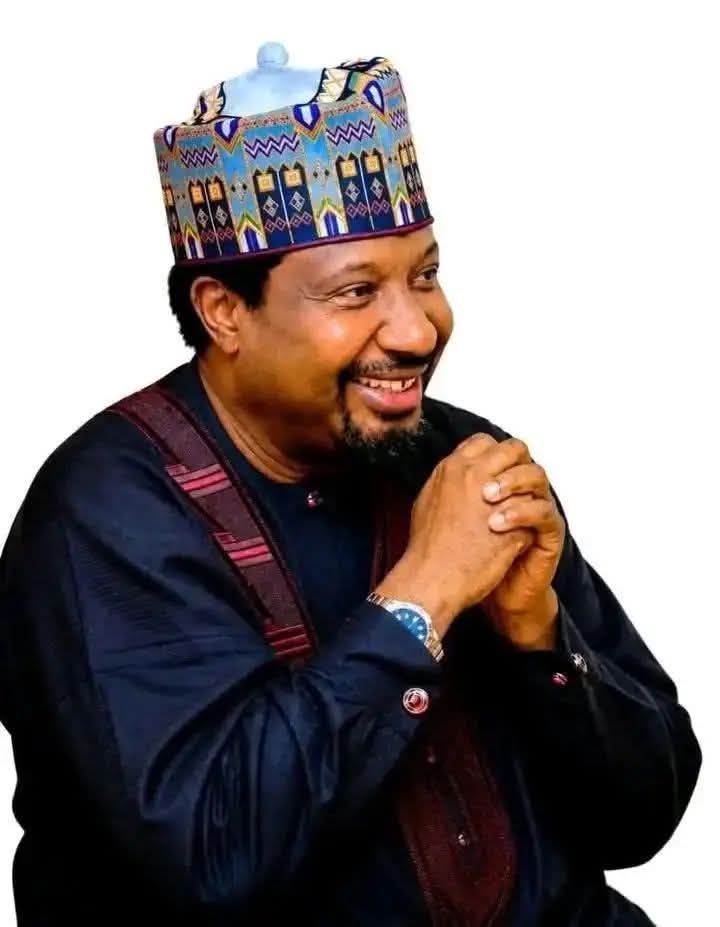
…The Principal has spoken, now let the “Barau Boys Listen.
By Shariff Aminu Ahlan
In the unpredictable theatre of Nigerian politics, political relationships are often misunderstood, deliberately distorted and sometimes exploited by individuals who seek relevance by speaking in the names of powerful political figures. But when it comes to the relationship between Deputy Senate President Senator Barau I. Jibrin and Kano State Governor Abba Kabir Yusuf, the facts and recent actions speak louder than the noise.
Senator Barau has publicly demonstrated a willingness to work with Governor Abba Kabir Yusuf and has called for political cooperation within the APC. Whatever individual opinions may exist among people around him, they should not be confused with the position of the Deputy Senate President himself.
This distinction has become particularly important following the recent removal of Umar Alhassan, popularly known as King Indara, from his position as Special Legislative Assistant in Barau’s office. According to reports, the removal followed social-media posts carrying the message “Abba Must Go.” Barau’s media office said the conduct amounted to indiscipline and disrespect and was inconsistent with the principles expected of members of his office and the APC. The removal took effect on September 18, 2026.
That development sends a clear message about the difference between Barau Jibrin’s position and the personal opinions of individuals within or around his political structure. Those who criticize Abba are entitled to their personal political opinions, but they cannot automatically present those opinions as the position of Barau Jibrin.
Indeed, if the recent action against King Indara is anything to go by, membership of Barau’s political family cannot be used as a license to undermine a position publicly associated with the principal. The issue is therefore bigger than one individual. It is about political discipline, loyalty to an established direction and the responsibility of people who operate within the structure of a highly influential public figure.
And this is where Senator Barau’s stature must be properly understood. Barau Jibrin’s political influence did not emerge overnight. His standing has been built through years of legislative activity, political organization, constituency representation and national responsibilities. In the 10th National Assembly alone, records reported in June 2026 show that he had sponsored 42 bills in three years, with five already passed by the National Assembly. The bills span education, healthcare, agriculture, governance, economic development, constitutional reform, renewable energy and other areas of national importance.
Among those that had passed were legislation establishing the North West Development Commission, the Federal Medical Centre in Gwarzo and the Federal University of Science and Technology in Kabo, alongside other measures dealing with national institutions and economic development. His legislative portfolio also includes the E-Health Bill and proposals addressing maternal, newborn and child healthcare.
These are not achievements that can simply be reduced to political slogans. They form part of a documented legislative record that has contributed to Barau’s reputation as one of the most active private-member bill sponsors in the 10th Senate.
Beyond the Senate chamber, Barau has also occupied important leadership responsibilities, including his position as Deputy President of the Senate and his role as First Deputy Speaker of the ECOWAS Parliament. His activities have extended beyond legislation into education, healthcare, empowerment and community-development initiatives, particularly across Kano North.
It is therefore difficult to reduce a political figure of this magnitude to the statements of a few individuals who happen to operate around him.
Those who have chosen to criticize Governor Abba Kabir Yusuf while claiming association with Barau should understand that speaking for oneself is different from speaking for Barau. Political proximity does not automatically confer the authority to announce the position of the principal.
The recent King Indara episode has consequently become a significant development in the political conversation. It demonstrates that Barau’s office can take disciplinary action when the conduct of an aide is considered inconsistent with the standards and political principles expected from that office. It should not, however, be interpreted as proof that every other person with a different political opinion will necessarily face the same fate. What it does establish is that Barau’s office has drawn a line between personal political expression and conduct expected from those officially serving under him.
For those attempting to manufacture friction between Barau and Abba, the challenge is straightforward: the principals should be allowed to define their own relationship.
No aide, supporter, political commentator or self-appointed spokesman can create a political war between two leaders simply by repeatedly claiming that one of them is against the other.
Barau’s political career has placed him in a position where his decisions carry consequences far beyond the individuals immediately surrounding him. He therefore has every reason to distinguish between genuine political strategy and the personal ambitions or grievances of individuals who may attempt to exploit his name.
The emerging message is clear: Barau Jibrin’s political position should be measured by Barau Jibrin himself, not by anybody claiming to be a “Barau boy.”
And while political disagreements will inevitably exist within every political structure, they should not be deliberately transformed into evidence of a disagreement between the principals.
Governor Abba Kabir Yusuf has his political identity, political structure and public record. Senator Barau Jibrin has his own enormous political influence, legislative record and responsibilities. Where their interests and political objectives converge, that convergence should be acknowledged for what it is rather than distorted by individuals seeking to create suspicion.
For Barau, the bigger picture is clearly much larger than the activities of individual aides. His legislative output, national responsibilities and developmental interventions have established a political profile that cannot be defined by social-media controversies.
The same applies to his relationship with Abba. The bond between Barau Jibrin and Abba Kabir Yusuf should therefore be judged by the actions, statements and decisions of Barau and Abba themselves, not by disgruntled individuals attempting to speak over their principals.
Those who genuinely belong to Barau’s political family should understand the difference between personal ambition and collective political direction. They may hold personal opinions, but they should not attach those opinions to Barau without his authorization.
As the 2027 political season approaches, the real story is not the noise generated by individuals on the sidelines. The real story is whether the political leadership of Kano can build cooperation around development, stability and the interests of the people.
And if Senator Barau’s documented legislative record is anything to go by, his political relevance is already firmly established, not merely by the number of positions he occupies, but by the breadth of legislation, institutions and development initiatives associated with his years in public service.
Barau Jibrin has built a political identity too substantial to be defined by the voices of a few disgruntled elements. His relationship with Abba should be understood through the actions of the two principals, while those operating within his structure must recognize that political loyalty comes with responsibility.
The noise may continue, but the principals will ultimately speak through their actions.
Shariff Aminu Ahlan
APC Intellectual Warrior.
realahlan0101@gmail.com
08034533848.