

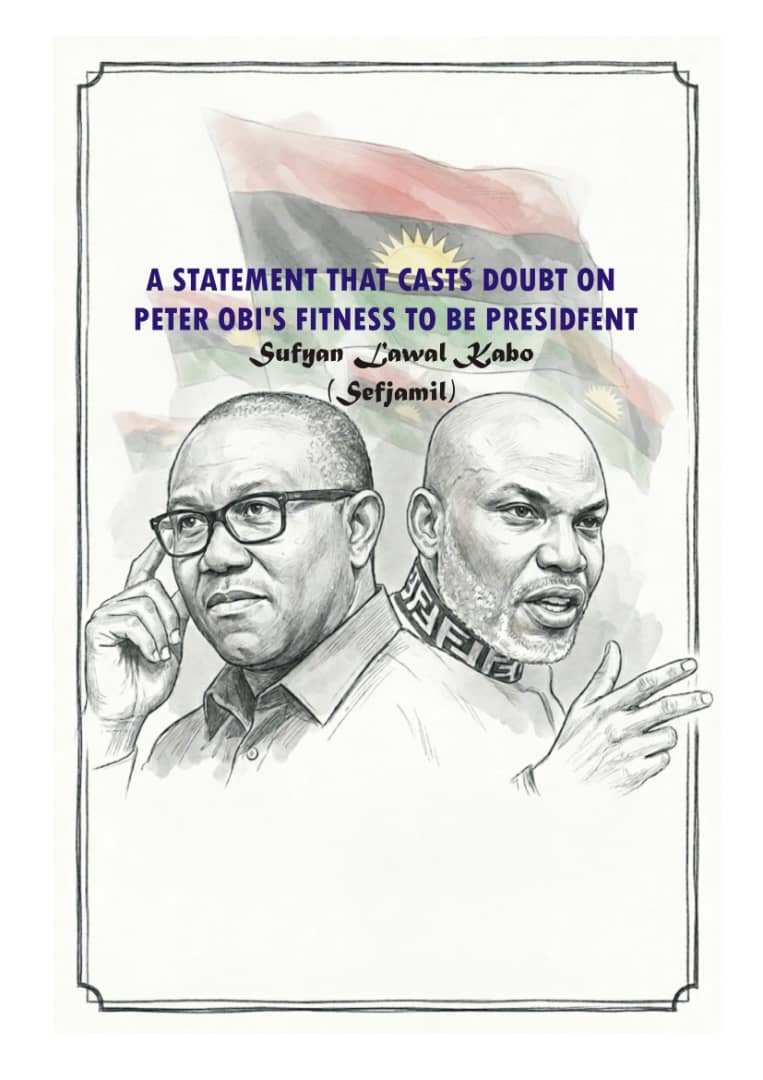
My Analysis of the Political, Security, and Leadership Implications of Peter Obi’s Pledge to Release Nnamdi Kanu if Elected President.
by Sufyan Lawal Kabo (Sefjamil)
sefjamil3@gmail.com
I woke up around 4:30 a.m. on June 13th and as usual, I reached for my phone. I checked my notifications and went straight to Facebook to catch up on the pulse of the nation. Then, I saw it: “I will release Nnamdi Kanu if I become president,” says Peter Obi.
Initially, I scrolled past it. ‘One of the online lies’ I thought. I didn’t want to believe that any man aspiring to the highest office in this country could be foolish enough to utter such a volatile statement at such a fragile moment. I also doubted the source – it was reported by one of these newly established media houses whose most reports are mostly banner-based. As a student of Mass Communication, I know that credibility of news source matters the most. I scrolled down until I saw the banner headline on Premiere Radio page. My heart sank.
The story was true!
Let us be clear about who Nnamdi Kanu is. He is a criminal who orchestrated a killing spree in Lagos, ordered the beheading of police and military officers, turned the Southeast into a slaughterhouse, and forced thousands of innocent citizens including Northerners living in Southeast to flee their homes. He is the man who referred to this great country as a “Zoo” and its citizens as animals and mad people. A man who got busy gathering support in foreign countries to acquire weapons for a potential war with the Nigeria that Peter Obi wishes to lead.
Yet, Peter Obi, a man who wants to lead this country, views this terrorist as someone “…he would release if he becomes president”.
The audacity of this promise is staggering. By vowing to release a man convicted of terrorism and treason, Obi has effectively declared his true deadly intention against the Nigeria state, and his ties with the architects of its instability (IPOB and its leader, Nnamdi Kanu). Only a man consumed by political desperation like Peter Obi would claim to stand for justice while turning a blind eye to the innocent citizens who were maimed, slaughtered, beheaded, extorted, and silenced under the reign of terror unleashed by Nnamdi Kanu’s IPOB/ESN. How does Obi condemn Boko Haram and their ilk wholeheartedly in one breath, only to embrace, defend, and rationalize IPOB in another? The truth is someone seeking to lead over 200 million people of diverse ethnicity and religious belief is openly showing support to a terrorist group because they are from his region is a dangerous candidate.
Kano first
For Northerners and people in the Southeast who have suffered under the IPOB reign of terror, those who have lost businesses, livelihoods, and loved ones, this is not just politics; it is a direct threat to their survival. This is a man who remained silent while the Southeast burned, while Northerners now finds his voice to advocate for the very man responsible for that fire. This is not leadership; it is naked ethnic favoritism.
My mind wandered to a conversation I had long ago with an elder. He told me, “Shi fa Inyamiri babu jinin mulki a jikin sa – kuma bazai taba iyawa ba” (An Igbo man isn’t born to rule, they have no leadership spirit in them). I resisted this thought for years, but looking at our history, one cannot help but see the pattern.
Historically, the Igbo political model differs sharply from the monarchy-based systems of the North or the West. Their tradition lacks a central, unified government structure, which often results in a fractured approach to governance. We saw this with Dr. Nnamdi Azikiwe, whose presidency was plagued by accusations of tribalism that ultimately destabilized his tenure. We saw it with Aguiyi-Ironsi, who displayed his leadership incapacity when he refused to punish the January 1966 coup plotters, instead, he pampered them and introduced the unitary system designed to consolidate power for his kinsmen.
Peter Obi is merely the latest chapter in this tragic tradition. His political career is a laundry list of exclusionary behavior. Remember, as Governor of Anambra, he oversaw the demolition of the Hausa cattle market in Onitsha, which had existed since 1974. When the traders protested, soldiers were deployed, and seven Hausa men were gunned down. There was no relocation, no compensation, no empathy, only the cold exercise of power.
Obi has never hidden his bias. During his campaign, he weaponized religion in churches with his “Take Back Your Country” rhetoric, a divisive tactic that a true national leader would never employ. He has consistently denied that IPOB is a terrorist organization, claiming he “lives with them” in Onitsha. If a man can ‘live’ peacefully alongside those burning government infrastructure and murdering security personnel, what kind of security will he provide for the rest of Nigeria?
His promise to release Nnamdi Kanu is the final nail in the coffin of his presidential ambitions. He has shown us exactly who he is: a regional champion, a man drowning in political confusion, and a candidate who prefers to dress up terrorism in the garb of sentiment.
Rather than feeling disappointed, those supporting Peter Obi should be grateful for the clarity his recent statements have provided regarding his political trajectory. The growing public awareness, fueled by diligent analysis and prayer, is revealing the potential implications of his leadership, prompting a significant shift in his support base.
Many who previously backed him, including loyalists of the Kwankwasiyya movement and individuals from the Southeast who have personally endured the violence, displacement, or loss of family members at the hands of IPOB, have withdrawn their support following his pledge to release Nnamdi Kanu. They now understand that Peter Obi does not mean well for Nigeria. As of Rabiu Musa Kwankwaso, he was only marketing Obi for his selfish reason: to fuel a grudge that he (Kwankwaso) holds against the ADC presidential candidate, Atiku Abubakar, the incumbent President, Bola Ahmad Tinubu and Kano state Governor, Abba Kabir Yusuf.
To those still captured by his rhetoric, the evidence is stark: a presidential candidate would have speak as a unifying father figure to the nation, not as a facilitator for a terrorist like Nnamdi Kanu, who seek its fragmentation. Nigeria requires a leader committed to the absolute rule of law, not one willing to negotiate with terrorists. By advocating for the release of individuals linked to acts of terror, Peter Obi has demonstrated a fundamental misalignment with the responsibilities required to govern and secure the nation.
Conclusion:
Nigeria’s security situation remains complex, but ongoing efforts have recorded notable progress, including intensified counterterrorism operations, disruption of criminal networks, improved inter agency coordination, and more intelligence driven responses that have in several cases led to the rescue of abducted persons and gradual strengthening of operational capacity.
President Bola Ahmed Tinubu’s administration is sustaining these efforts with renewed commitment and more adaptive strategies. However, insecurity remains a dynamic challenge that requires deep institutional experience and coordinated national capacity. It is therefore important to understand that such a responsibility cannot be effectively managed by political ambition alone or by individuals without tested federal governance experience and a clear grasp of Nigeria’s security architecture.
Sefjamil writes from Abuja