

By Aishatu Haruna
There comes a point in every political administration when it becomes clear that some appointees are more than the offices they occupy. They become interpreters of government vision, bridges between government and the people, and, sometimes, architects of political possibilities.
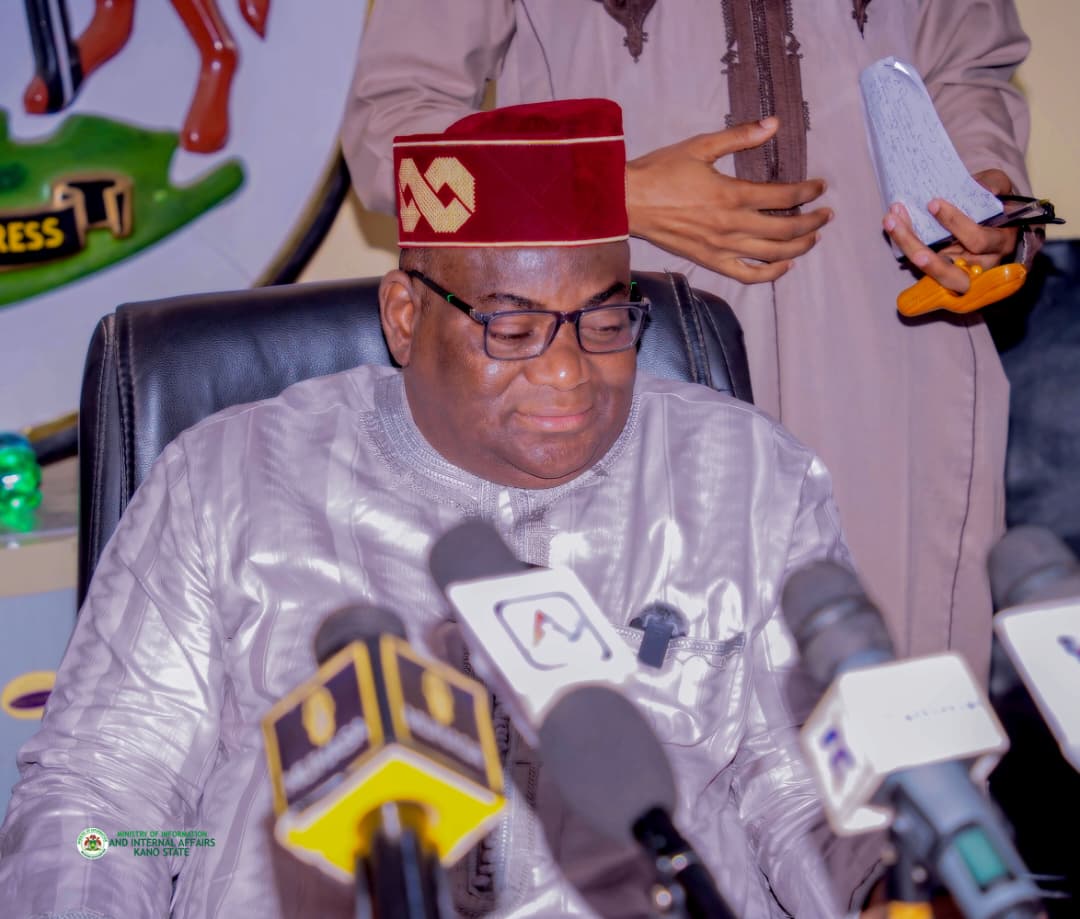
Comrade Ibrahim Abdullahi Waiya appears to have entered that category.
Officially, he is the Commissioner for Information and Internal Affairs of Kano State. But politics is rarely defined by official titles alone. It is defined by what individuals do with the responsibilities entrusted to them.
That is what makes Waiya politically significant.
A Commissioner for Information is traditionally expected to explain government policies. A good commissioner goes further by helping the public understand those policies. A politically effective commissioner goes further still—building relationships, managing tensions and creating the confidence necessary for political stability and continuity.
This appears to be one of the most notable aspects of Waiya’s current political relevance.
His public engagements have increasingly gone beyond conventional publicity. From defending government policies and articulating the philosophy of Kano First to responding to contentious political narratives, he has demonstrated that information management in contemporary politics is not merely about issuing statements. It is also about shaping public perception, managing tensions and sustaining constructive political conversations.
But there is another dimension of the Waiya phenomenon that deserves attention.
Politics is ultimately about people.
Policies do not vote. Buildings do not vote. Press releases do not vote. Political structures are built, sustained and tested by people.
Therefore, any political actor who understands how to win people without humiliating them possesses valuable political capital.
This is where Waiya’s engagement with opposition figures and, more recently, his outreach to serving councillors becomes worthy of consideration.
It may be described as mobilisation, political realignment or strategic engagement. Whatever terminology one chooses, the underlying principle remains the same: people move when they find compelling reasons to move.
Political persuasion is not always about defeating an opponent. Sometimes, it is about convincing people that there is a larger political space in which everyone can participate.
That distinction matters.
A mature politician does not necessarily regard every opposition member as a permanent enemy. An opponent may disagree today and cooperate tomorrow. Democracy is not about permanently dividing citizens into enemies and friends; it is about managing differences in pursuit of a common society.
If Waiya’s political engagements succeed in bringing people across old partisan boundaries, his contribution may eventually be measured not simply by the number of people he persuades, but by the number of political barriers he helps dismantle.
That is what makes a commissioner a political asset.
A political asset is not necessarily the loudest person in the room. Sometimes, it is the person who understands when to speak, what to say, whom to engage and, perhaps most importantly, when to remain silent.
Waiya’s strongest political currency appears to be communication.
But communication is not simply the ability to talk. It is the ability to connect.
Talking fills the air; communication changes understanding.
Talking may win an argument; communication may build a relationship.
Talking can produce applause; communication can produce movement.
And politics, ultimately, is about movement.
This perhaps explains why Waiya has become a visible defender and interpreter of Governor Abba Kabir Yusuf’s administration. His interventions have repeatedly placed him at the intersection of governance, politics and public perception.
In January 2026, for instance, he challenged narratives surrounding Governor Yusuf’s political future and argued against reducing Kano’s political destiny to the influence of a single political godfather.
Whether one agrees with every position he takes is beside the point. What matters is that he understands that political silence also communicates.
A government without a strong voice can easily surrender its narrative to its opponents. Similarly, a government whose communication lacks conviction can lose the battle for public confidence even when its policies are sound.
Waiya appears to understand this responsibility.
Yet there is a deeper question: What makes a person politically valuable?
Is it position, popularity, access to power, ability to mobilise crowds, proximity to the governor, or the capacity to contribute meaningfully to a larger political project?
I would argue that the last is most important.
A political appointment is a trust. A political asset is someone who multiplies the value of that trust.
Such a person does not merely occupy political space; he creates value within it.
He builds confidence where there is suspicion. He creates dialogue where there is hostility. He explains where there is confusion. He defends where necessary and, where possible, persuades without insulting.
That last quality is particularly important in Kano’s competitive political environment.
For politics to mature, politicians must recognise that today’s opponent may become tomorrow’s ally, just as today’s ally may eventually become tomorrow’s opponent.
Wisdom therefore demands restraint.
Political disagreements should not automatically become permanent personal hatred. Bridges should be preserved even when political roads temporarily separate.
This is why Waiya’s engagement with opposition figures deserves to be viewed beyond the immediate arithmetic of party politics.
There is a broader philosophy at work: inclusion can sometimes be more powerful than conquest.
When a political actor brings another person closer, he does not necessarily diminish himself. Sometimes, he expands the political space available to everyone.
The recent attention surrounding Waiya’s engagement with councillors is significant, not merely because councillors represent an important layer of political organisation, but because grassroots politics operates at that level.
The councillor knows the ward, the community and the everyday political concerns of the people. He understands the grassroots pulse in ways that speeches delivered from government offices cannot always capture.
To engage such people is to engage the roots of politics.
Perhaps Waiya’s greatest political asset is his ability to combine the language of government with the language of grassroots politics.
He speaks as a commissioner, but appears to understand the psychology of the political activist.
He operates within government, but retains the instincts of a political mobiliser.
He communicates policy, but understands persuasion.
That combination is rare.
It is also powerful.
Of course, appreciation should not become hagiography. No public official is beyond criticism, and no political strategy is without risks. Political realignment can generate suspicion, while aggressive political advocacy can sometimes blur the boundary between government communication and partisan mobilisation.
Every political bridge must ultimately be judged by where it leads.
Acknowledging these realities, however, does not diminish Waiya’s contribution. Rather, it makes the appreciation more meaningful.
The real compliment to a public servant is not that he is perfect. It is that he is useful to the people and purposeful in the service entrusted to him.
Waiya’s story, therefore, may be less about being the commissioner who speaks the most and more about being the commissioner who understands that words can serve as political infrastructure.
A road connects places.
A bridge connects people.
Words can connect minds.
And sometimes, the most consequential political bridge begins with a conversation.
This is why the title “When a Commissioner Becomes a Political Asset” is not merely praise. It is an observation.
Waiya has demonstrated that a Commissioner for Information can become much more than the custodian of government publicity. He can become a political interpreter, a defender of institutional confidence, an advocate of a governing philosophy and, when wisely deployed, a bridge-builder across political divides.
His recent recognition as a finalist in the 2026 National Spokespersons Awards in the Crisis Communicator category adds an interesting professional dimension to his growing reputation.
But awards, commendations and newspaper headlines will eventually fade.
What may endure is more difficult to measure: the number of minds he influenced, relationships he strengthened, misunderstandings he clarified, people he brought closer and political bridges he helped construct.
That is the higher test of political usefulness.
Perhaps that is the most generous way to understand Comrade Ibrahim Abdullahi Waiya today—not simply as a commissioner who happens to be politically active, but as a political asset who happens to occupy the office of commissioner.
There is a subtle difference.
One describes a man by his office.
The other describes an office by the value of the man occupying it.
And in the theatre of politics, that difference can be everything.
Waiya, therefore, is not merely carrying the government’s message. He is increasingly participating in the conversation about what kind of political community Kano can become—one in which persuasion can replace hostility, engagement can soften rivalry, and political differences need not become permanent divisions.
That is worthy of recognition.
And perhaps, in the final analysis, the greatest political asset is not the man who knows how to win against people, but the man who knows how to win people.