

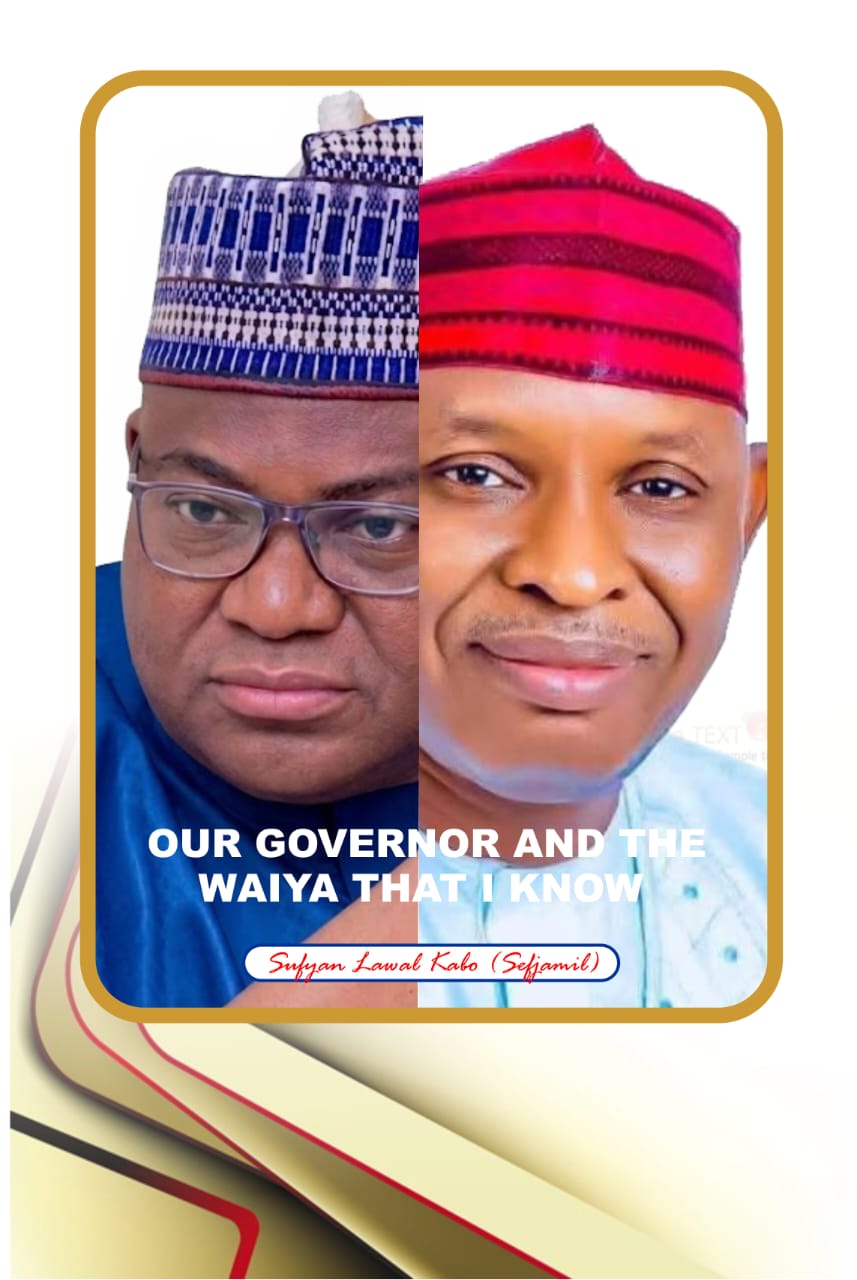

By Sufyan Lawal Kabo (Sefjamil)
sefjamil3@gmail.com
My phone rang and I quickly picked it up.
“Hello.”
It was my boss, the Executive Director of Centre for Information Technology and Development (CITAD), Malam Y. Z. Ya’u.
“See me in my office now,” he said briefly in his usual commanding tone before ending the call.
When I entered his office, seated across his desk was a man I had never met before. That man was Amb. Ibrahim Abdullahi Waiya. I was introduced to him and invited to participate in one of the development projects he was coordinating. That meeting marked the beginning of a relationship that has lasted since 2012. Over the years, we worked together on several development programmes supported by local and international development partners until Governor Abba Kabir Yusuf found him worthy of serving Kano State as Commissioner for Information and Internal Affairs.
Some people may wonder why I began this write up with this personal story. The reason is simple. I have written several articles about Amb. Ibrahim Waiya, and I want people to understand that I am not doing so because of politics or personal gain. I write about him because I know him. I know his capacity, his commitment to public service, his patience in handling difficult assignments, and his ability to build bridges across institutions and communities. Having worked closely with him for years, I can confidently say that Governor Abba Kabir Yusuf is fortunate to have someone with such experience and strategic thinking in charge of one of the most sensitive ministries in government.

That is why, while many people discussed the recent gathering of commissioners, advisers, Senior Special Assistants, Special Advisers, board members and other political appointees at the Coronation Hall from different perspectives, I viewed it through another lens. Beyond the politics, I saw it as a meeting designed to strengthen governance through better coordination. The Governor reviewed government performance, reminded appointees of their responsibilities, called for unity, directed them to engage more closely with the ruling party, urged them to take government achievements to the grassroots, and challenged everyone to work harder towards delivering better service to the people of Kano.
The truth is that every one of those objectives depends heavily on one ministry more than many people realise, the Ministry of Information and Internal Affairs. Government policies cannot succeed if citizens do not understand them. Ministries cannot effectively work together without proper communication and coordination. Development programmes cannot receive public support unless they are properly explained. Achievements cannot speak for themselves unless somebody tells the story accurately, consistently and credibly.
This is exactly where Waiya has quietly distinguished himself since assuming office. Rather than limiting the ministry to issuing press statements, he has steadily transformed it into a coordinating platform that works closely with ministries, departments, agencies, media organisations, civil society groups, community leaders and other critical stakeholders. Through regular engagement, strategic communication, public enlightenment, inter agency collaboration and prompt information management, the ministry has continued to build public confidence in the programmes of the Abba Kabir Yusuf administration while ensuring that government activities receive the visibility and understanding they deserve.
Looking at the Governor’s latest directives, one can easily see that their successful implementation will require this same approach. Mobilising political appointees, promoting government achievements, strengthening unity within government, improving policy coordination and maintaining public trust are all responsibilities that naturally place the Ministry of Information at the centre of the process. Fortunately, the ministry is being led by someone who understands both governance and communication, and who has spent years building consensus long before joining government.
Governor Abba Kabir Yusuf has clearly outlined his mission. The responsibility now rests on every appointee to translate that vision into measurable results. From what I know of Amb. Ibrahim Abdullahi Waiya, I have no doubt that he will continue to play his part with the same commitment, quiet determination and strategic coordination that I first witnessed many years ago in the office of Malam Y. Z. Ya’u. Sometimes, the success of a government is not determined only by the quality of its policies, but by the quality of those entrusted with communicating, coordinating and driving them. In that regard, Kano State has every reason to be optimistic.
Sufyan writes from Kano