
…How derogatory and castigating remarks against Northern builders have flooded the media space.
By Shariff Aminu Ahlan
It is indeed horrific and heartbreaking to watch our Northern heroes, the selfless leaders who dedicated their entire lives, making priceless efforts with zeal and commitment, sacrificing their own safety and that of their children, working day and night with the singular purpose of building a better region that could compete with its Southern counterpart.
These were leaders who strove to educate the North and help it catch up with the South, which had earlier contact with European explorers. They worked tirelessly to secure a better position for the region within Nigeria’s corporate existence. Leaders whom we once held in the highest esteem are today being mocked, abused, castigated, blacklisted, and shamelessly portrayed as insignificant when compared to the modern-day egocentric and self-assumed leader of a misguided political fraternity, Senator Rabiu Musa Kwankwaso.
This newly invented pattern has been adopted by some members of the Kwankwasiyya bloc, apparently under the direction of their supreme leader.
Millions of people are disturbed and left wondering what is really wrong with Kwankwaso. This phenomenon is not limited to our ancient city alone; it is a scenario unfolding across Northern Nigeria. However, the answer is not difficult to identify.
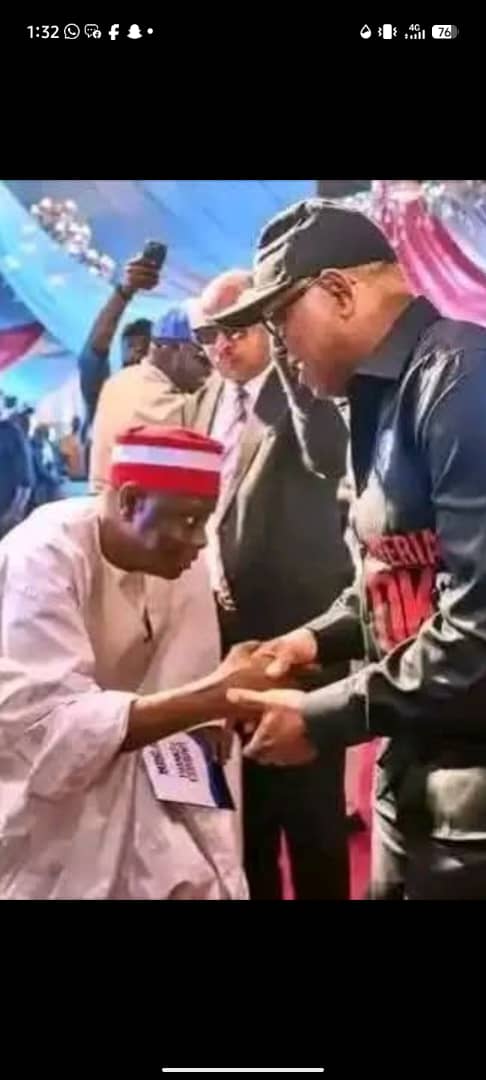
Kwankwaso’s sudden political U-turn to become the running mate of Peter Obi, a man he once considered politically inferior to his own long-established record — is, according to this argument, linked to several hidden factors. Beyond political considerations, there are other angles, including what appears to be an attempt to gain sympathy from the United States.
Come with me.
The first reason, which is of utmost importance to Kwankwaso in pursuing his objective, is as follows:
If it may be recalled, in February 2026, two members of the United States Congress reportedly introduced a resolution proposing sanctions against certain Nigerians. The proposed measures allegedly included travel restrictions to the United States, the United Kingdom, Europe, and other allied nations.
The resolution also reportedly called for sanctions on overseas assets belonging to those individuals based on accusations of supporting terrorism, particularly Boko Haram, and involvement in the implementation of Sharia law.
Among the names reportedly mentioned was Kwankwaso, although, in my view, the allegations against him were false. What is surprising, however, is that this development was allegedly fueled by writings and campaigns from IPOB supporters, Peter Obi’s followers known as Obidients, and some Christians from both Northern and Southern Nigeria. They reportedly claimed that Christians in Nigeria were victims of genocide and that religiously motivated Muslims were responsible for such acts.
It was widely reported and accepted in some Western circles that these allegations were credible. Although Kwankwaso and the Nigerian government denied the claims, it is further alleged that President Donald Trump ordered U.S. military operations in Sokoto State and deployed troops into Nigeria. According to this argument, the action carried symbolic significance.
Sokoto is regarded as the seat of the Sokoto Caliphate established by Sheikh Usman Dan Fodio. Therefore, the military action was interpreted by some as an attack on Islam and Northern Nigerian Muslims, who had been accused of committing genocide against Christians across the country.
These allegations reportedly created serious concerns for Kwankwaso because being publicly linked to terrorism and Islamic extremism, such as Boko Haram, could have severe consequences.
For this reason, Kwankwaso allegedly concluded that the best way to change American perceptions about him was to support Peter Obi’s presidential ambition and position himself as Obi’s running mate.
It is worth recalling that during the 2023 presidential election, Peter Obi was perceived by many as drawing significant support from Christian communities. Much of his campaign activity reportedly focused on churches because he believed that, having already secured strong backing from his Igbo base in the South-East and Christians in the Niger Delta, gaining the support of Northern Christians would further strengthen his chances of victory.
After deciding to support Peter Obi, Kwankwaso allegedly encouraged some of his supporters, including beneficiaries of overseas educational programs, to criticize the legacy of Sir Ahmadu Bello, the Sardauna of Sokoto and the first Premier of Northern Nigeria.
Ironically, it is further alleged that this criticism extended even to Sheikh Usman Dan Fodio, the founder of the Sokoto Caliphate and a central figure in the history of Islam in the region. According to this argument, these actions were intended to demonstrate to Americans, Europeans, and even Israel that Kwankwaso was not an Islamic extremist and had no connection to groups such as Boko Haram.
By distancing himself from historical Islamic figures and criticizing Fulani communities associated with insurgent figures such as Bello Turji and Dogo Gide, Kwankwaso allegedly sought to improve his international image.
It is unfortunate, according to this perspective, that all of this was done primarily to protect Kwankwaso’s personal interests and persuade Western governments and Christian communities in Nigeria to reconsider the allegations against him.
This, according to the argument, explains why some of his supporters openly criticize the Sardauna of Sokoto and accuse him of historical injustices against the Hausa people, at a time when movements promoting a “Hausa-only” identity have emerged and are allegedly attempting to create divisions between Hausa and Fulani communities in Northern Nigeria.
This troubling situation poses a significant threat to Northern Nigeria, and it is all being driven by the ambitions of a single individual.
Anyone who carefully reflects on the matter can understand what Kwankwaso’s objectives may be, even while many of his followers believe these actions will help their leader achieve his political aspirations if Peter Obi becomes President.
According to this perspective, they believe that Kwankwaso could eventually become President of Nigeria because Obi allegedly promised to serve only one term. Under that arrangement, Obi would step down in 2031 and support Kwankwaso’s presidential ambition.
What a myopic and childish assumption.
Kwankwaso himself knows that Peter Obi is unlikely to win the next election. Therefore, if Obi loses again, Kwankwaso could then argue that it would be the North’s turn to reclaim power. And if Atiku Abubakar is unsuccessful in future elections, age and other factors may prevent him from contesting again.
Another reason, according to this argument, is that Kwankwaso’s support for Peter Obi at this time is based on the belief that their alliance may not ultimately succeed. In that event, Kwankwaso could later claim that he had made a reciprocal gesture and therefore the North should produce the President in 2031.
That, according to this perspective, is the political calculation of a man who views power as a destination that must be reached and is prepared to pursue his ambitions even at the expense of long-preserved integrity and the indisputable service rendered by our Northern heroes.