

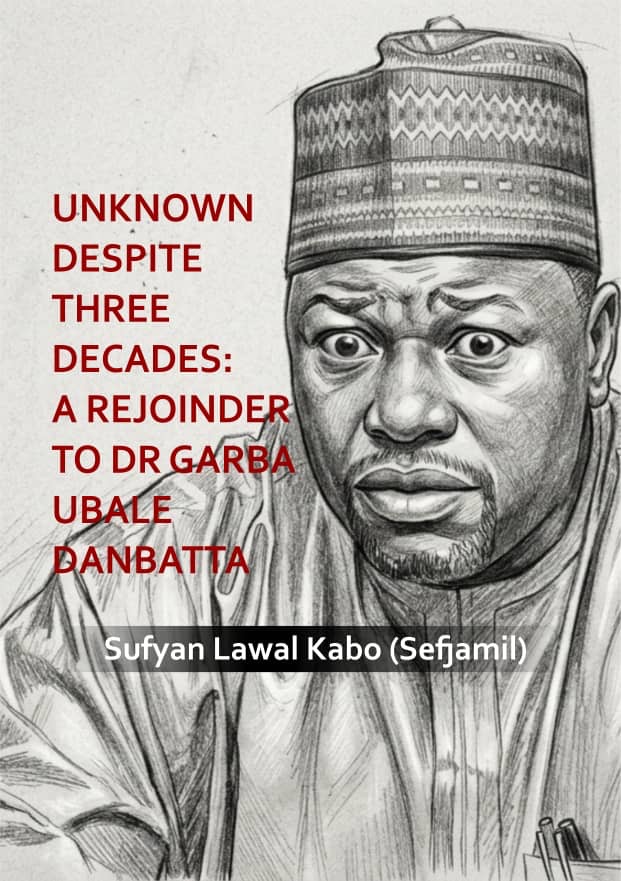
By Sufyan Lawal Kabo (Sefjamil)
I was in my office when I came across a publication in which Dr Garba Ubale Danbatta, a journalist associated with Pyramid Radio, praised Governor Abba Kabir Yusuf for “removing” Dr Ibrahim Abdullahi Waiya as Commissioner for Information and Internal Affairs. Mustapha, a fellow journalist with about twenty years of experience, read the report and asked me, “Who is Garba Ubale Danbatta?” I laughed and replied, “If a journalist with twenty years in the profession like you does not know someone who claims to have spent thirty years in it, perhaps Danbatta is struggling to become somebody by attacking somebody who is already somebody.”
I was preparing an open letter to thank Governor Abba Kabir Yusuf for redeploying Waiya when this stranger came up with his brouhaha. The Governor appointed Waiya because he believed in his capacity and has now entrusted him with another demanding responsibility.
Danbatta, after thirty years in journalism, you should know that professional criticism requires evidence, context and fairness, not sweeping conclusions. You appear to have confused the responsibilities of a Commissioner for Information with those of a newsroom journalist. Did the Governor appoint Waiya to edit newspapers or run a newsroom? Certainly not. The Ministry of Information and Internal Affairs has broader responsibilities, including government communication, public enlightenment, public relations, policy advocacy, crisis communication, internal peace, public order and community relations. Calling these activities activism does not make them professionally wrong.
You proudly listed your experience with Deutsche Welle Hausa in Bonn, Daily Trust, Rariya, Hamada Radio, Kiss FM Abuja and Radio Nigeria. We respect those institutions, but thirty years in journalism is not a monopoly on professional wisdom. A list of employers does not establish exceptional achievement, just as longevity does not guarantee impact. After three decades, one would expect lasting professional contributions. Yet many journalists, including my colleague with twenty years of experience, do not know you. What enduring contributions have you made, and who have you mentored? Perhaps attacking Waiya is your attempt to establish relevance in Kano’s political and media conversation. If so, it is a poor way to seek recognition.
More importantly, what exactly did Waiya do wrong? You alleged that his activities damaged Kano State’s reputation among organisations monitoring media freedom and journalists’ rights. Name these organisations, publish their reports or petitions, and identify the specific provisions of the Nigerian Code of Ethics for Journalists he violated. Where are the investigations establishing these violations? Serious allegations require evidence, not repeated references to thirty years of experience.
Waiya’s tenure had identifiable achievements. He facilitated capacity-building programmes for information officers across the 44 local government areas, introduced performance-based recognition, pursued professional registration with the Nigerian Institute of Public Relations and the Advertising Regulatory Council of Nigeria, established a Digital Multimedia Department and inaugurated an 18-member Media Information Policy Drafting Committee in April 2026. He also emerged as a finalist in the 2026 National Spokespersons Awards in the Crisis Communicator category. Why ignore these contributions?
Waiya is no stranger to journalism. His background includes professional journalism, civil society, peacebuilding, public engagement and strategic advocacy. The Governor knew his professional background when he appointed him. Experience should be measured by contribution and impact, not merely by years spent in a newsroom. In the assessment of many, Kano has not had a Commissioner for Information who brought the same combination of energy, public engagement and institutional initiatives to the office as Dr Ibrahim Abdullahi Waiya.
It is also important to correct your description of the Governor’s decision. Waiya was redeployed, not dismissed from the State Executive Council. Cabinet adjustments are the Governor’s prerogative and do not prove incompetence or professional failure. Turning an administrative decision into an opportunity to pronounce another man’s professional death sentence is unfair and unprofessional: Gov. Abba Kabir is smarter than you.
It is no secret that Waiya faced opposition from political interests, particularly certain individuals close to the Governor whom we know. Some regarded the Ministry as a lucrative office from which public resources could be accessed without sufficient accountability. Waiya’s efforts to reposition the institution made them uncomfortable, and they attempted to discredit him because of their interest in the Ministry. Their attempts to remove him did not succeed, but political displeasure cannot justify distorting his record.
Danbatta, Kano has never had a Commissioner for Information quite like Dr Ibrahim Abdullahi Waiya. Many believe Governor Abba Kabir Yusuf recognised his hard work and capacity, hence entrusting him with the more demanding task of repositioning the Ministry of Youth and Sports Development, a vital ministry because young people are the bedrock of every society. We believe he has the capacity to deliver.
Nobody denies you the right to criticise Waiya. But if he violated professional ethics, provide the evidence. If he damaged Kano’s reputation, name the organisations. If he failed, identify the failures. If your intention was to advise the Governor on who should head the Ministry of Information, you could have done so without discrediting its former occupant. And if you intended to establish your relevance in Kano politics, there are more dignified ways to achieve that: this method is dead on arrival.
Thirty years in journalism should have made you a respected voice. But years alone do not create a legacy, and attacking another man will neither give you one nor make you popular.