

By Mohammed Babagana Abubakar
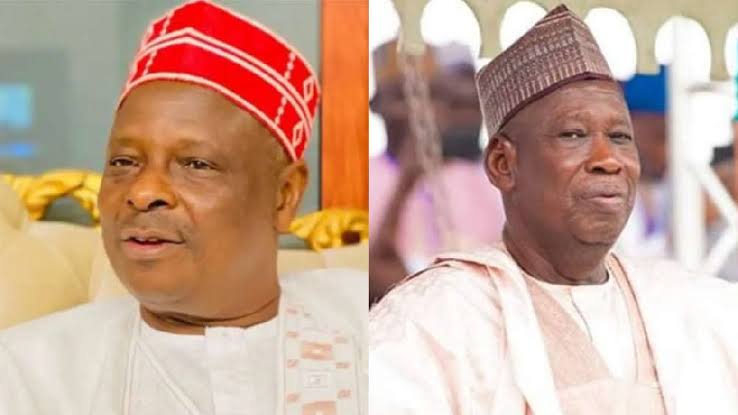
The trajectory of contemporary politics in Kano State cannot be fully understood without examining the complicated partnership and eventual rupture between Rabiu Musa Kwankwaso and Abdullahi Umar Ganduje. Though their public fallout after 2015 surprised many observers, recent revelations by political journalist Jaafar Jaafar concerning the 2015 Kano Central senatorial ticket reveal that the seeds of distrust and internal rivalry had already begun to germinate long before the dramatic collapse of the alliance.
Far from being an ordinary arrangement, the controversy surrounding the Kano Central ticket exposed the deeper mechanics of loyalty, succession planning, and strategic positioning within the Kwankwasiyya movement.
In late 2014, the newly formed All Progressives Congress was preparing for a historic national contest. At the center of that movement stood Kwankwaso, then completing his second tenure as Governor of Kano State and seeking the APC presidential ticket against heavyweights such as Muhammadu Buhari and Atiku Abubakar.
However, every ambitious presidential project requires contingency planning.
Kano Central, one of the most politically significant senatorial districts in northern Nigeria, needed a candidate. Yet political calculations demanded caution. if Kwankwaso failed to secure the APC presidential nomination, he would require a secure fallback position. The Senate seat therefore became an insurance policy.
To satisfy INEC deadlines while preserving Kwankwaso’s future options, the movement needed what political insiders often describe as an ajiyar tikiti a placeholder candidate who would temporarily hold the ticket and relinquish it whenever the principal returned.
According to Jaafar Jaafar, an important internal discussion emerged regarding who should hold the temporary Kano Central ticket.
“When Kwankwaso contested the presidency in 2015, it became necessary to give someone a temporary Kano Central senatorial ticket. While considering who should hold it, Ganduje advised Kwankwaso to give the ticket to Saleh (Kwankwaso’s younger brother, popularly known as Baba).”
On the surface, Ganduje’s recommendation appeared to be a gesture of absolute loyalty. Suggesting Kwankwaso’s biological brother would theoretically guarantee maximum trust and eliminate fears of betrayal.
Yet Kwankwaso reportedly rejected the proposal.
“At that time, Kwankwaso said, No, it is better to let Abba hold it. That is exactly what happened. It wasn’t a primary election that gave him the ticket; it was a placeholder deposit.”
The Abba in question was Abba Kabir Yusuf Kwankwaso’s trusted protege, former personal assistant, son in law, and then Commissioner for Works.
That decision was politically significant.
By bypassing his own brother and selecting Abba Kabir Yusuf instead, Kwankwaso quietly communicated where his deepest political confidence truly rested. It was not merely a family matter, it was a declaration about succession, loyalty, and institutional trust within the movement.
Viewed retrospectively, this episode provides a revealing snapshot of the tensions that would later consume the Kwankwasiyya Gandujiyya alliance.
Placeholder arrangements require extraordinary confidence. A temporary candidate must possess enough loyalty to surrender a powerful office without resistance once called upon.
By entrusting Abba Kabir Yusuf with the ticket, Kwankwaso effectively elevated him into the innermost circle of the movement’s power structure. For Ganduje then Deputy Governor and widely expected to inherit the governorship this may have signaled that despite their partnership in governance, there remained a political sanctuary to which he did not fully belong.
In Nigerian politics, recommendations often carry hidden strategic implications.
Ganduje’s suggestion that Saleh Baba Kwankwaso should hold the ticket was politically intelligent. Had the idea succeeded, it could have tied the Kwankwaso family more directly to the arrangement while potentially narrowing the influence of emerging loyalists within the movement.
Kwankwaso’s refusal demonstrated something equally important. ultimate strategic authority remained firmly in his hands. Ganduje may have been a governing partner, but the architecture of political succession was still designed exclusively by Kwankwaso himself.
Perhaps the most striking dimension of this story lies in its historical irony.
The individual selected merely to hold the Senate ticket in 2015 eventually emerged as the central political heir of the Kwankwasiyya movement. Eight years later, Abba Kabir Yusuf defeated the candidate backed by Ganduje’s political structure and became Governor of Kano State.
The placeholder of yesterday became the principal actor of today.
The revelations by Jaafar Jaafar are more than anecdotal political gossip. They offer a deeper understanding of how power is negotiated, protected, and transferred within Nigerian political movements.
The Kano Central senatorial ticket was never simply about representation in Abuja. It was a strategic instrument a test of loyalty, a mechanism of succession planning, and an early indication of the fractures developing beneath the surface of one of Kano’s most formidable political alliances.
In retrospect, the events of 2015 did not merely foreshadow the collapse of the Kwankwaso Ganduje partnership. They exposed the enduring reality of Nigerian politics. alliances survive on trust, but power ultimately gravitates toward those entrusted with the future.