

by Sufyan Lawal Kabo
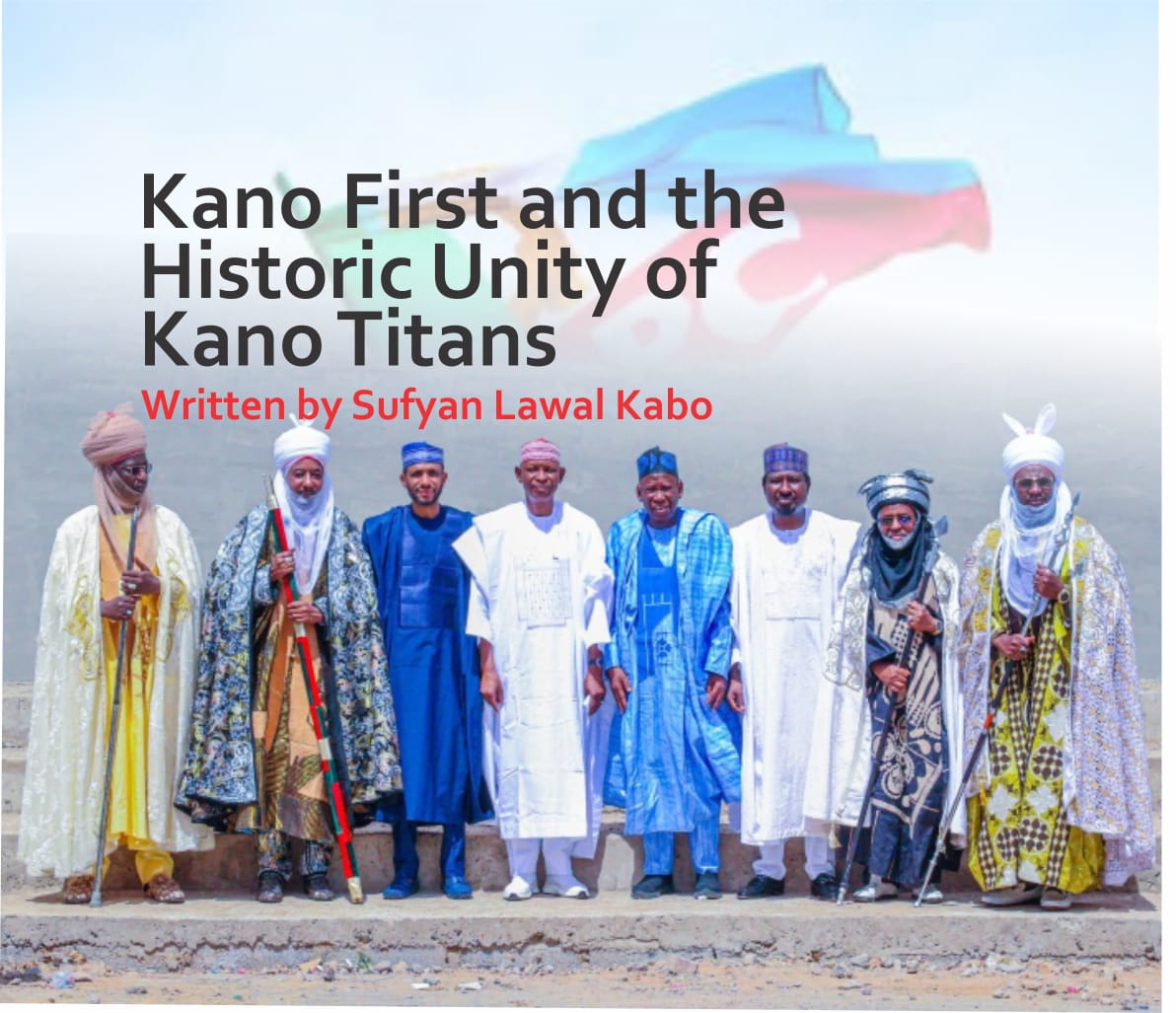
Seeing the picture referenced above genuinely lifted my spirit. It is not just a moment captured in time, it is a historic alignment of purpose. For years, I have quietly nurtured the hope of witnessing a genuine political convergence among Kano’s foremost leaders. Today, that vision is taking shape under the deliberate efforts and leadership of His Excellency Abba Kabir Yusuf.
For the first time in Kano’s long and rich political history, we are witnessing a rare unity among its most influential figures. From the Deputy Senate President, Barau I. Jibrin, to the revered Emir of Kano, Sanusi Lamido Sanusi II, former gover, Malam Ibrahim Shekarau, alongside former Governor Abdullahi Umar Ganduje, Honourable Abubakar Bichi, Distinguished Senator Abdurrahman Kawu Sumaila, the Deputy Governor Murtala Sule Garo, and importantly, the Member representing Kano Municipal Federal Constituency, Hon. Sagir Ibrahim Koki, this gathering represents more than presence, it represents purpose.
Honourable Sagir Ibrahim Koki stands out as a grassroots oriented legislator whose interventions speak directly to the needs of his people. From educational support initiatives to infrastructure development within Kano Municipal, his leadership reflects a deep understanding that true representation lies in tangible impact. His commissioning of school renovations and provision of learning materials to hundreds of students is not just philanthropy, it is investment in the future of Kano state.
Kano has thrived for centuries as a center of commerce, scholarship, and governance. Yet, sustained elite unity has often been missing. This moment therefore marks a defining shift. Unity at the top translates into stability at the grassroots, and stability is the foundation upon which development stands.
Allah says in Surah Al Imran 3:103: “Hold firmly to the rope of Allah all together and do not become divided.” This is both spiritual wisdom and a timeless governance principle.
When we examine the advantages of unity, we must also confront the consequences of disunity. Kano and the wider Northern region have, at various times, paid a heavy price for elite fragmentation. Political feuds have escalated into destructive rivalries. Youths, instead of becoming agents of development, are drawn into cycles of hostility. Communities become divided. Trust weakens. Governance suffers.
Disunity breeds impunity. It weakens accountability. It fuels corruption. Projects are abandoned because they are tied to opposing camps. Investors withdraw due to instability. Even security challenges are worsened when leadership lacks cohesion.
History provides a powerful lesson. Before the Rwandan Genocide, political division led to catastrophic destruction. Yet, through deliberate unity driven reforms under Paul Kagame, Rwanda transformed into one of Africa’s most stable and progressive nations. Unity turned tragedy into strength.
The Prophet Muhammad peace be upon him said: “The believer to another believer is like a building whose parts support each other.”
A Persian wisdom reminds us: “When hearts unite, even iron breaks.”
Looking deeper, the role of the Deputy Senate President, Barau I. Jibrin, offers a practical example of political maturity. His approach has consistently been one of calm strategy, mediation, and restraint. In a political climate where many thrive on confrontation, he has chosen quiet influence and bridge building.
Political maturity is not in reaction but in restraint. Leaders who manage differences wisely create long term stability. This is essential for continuity in governance and policy implementation.
Similarly, the statesmanship of Abdullahi Umar Ganduje reflects patience and composure. He remains a figure whose political style attracts alignment rather than division. His ability to endure criticism without unnecessary escalation has strengthened his standing as a unifier, drawing support not only within Kano but across the country.
As it is often said, a leader who unites multiplies strength, but a leader who divides diminishes it.
Kano is not an ordinary state. It is a political reference point for Northern Nigeria. Its history, influence, and strategic importance place it in a leadership position within the region.
For this reason, Kano’s political actors must embody discipline, maturity, and foresight. Their actions set the standard for others. When Kano stands united, the North finds direction. When Kano is divided, the consequences ripple widely.
Leadership by example remains one of the strongest forces in governance. A united Kano becomes a model for others, shaping political culture beyond its borders.
As I reflect on this rare convergence, I see more than a gathering. I see the emergence of a new political philosophy. One rooted in dialogue, mutual respect, and collective interest.
If sustained, this unity will usher in accelerated development, stronger institutions, improved security, and renewed investor confidence. Kano will reclaim its historic position as a beacon of political stability and leadership. Its lost legacy will return, not as memory, but as reality.
To me, this is what Kano First truly means. A commitment to place Kano above ego, above rivalry, and above division.
Allah reminds us in Surah Al Anfal 8:46: “Do not dispute lest you lose courage and your strength departs.”
Today, Kano has chosen unity.
Tomorrow, it will inherit greatness.