

A Legacy of Institutional Development, Professional Excellence and Digital Transformation
The effectiveness of government communication is not determined solely by the volume of information released to the public, but by the strength of the institutions, competence of personnel and systems responsible for delivering it. This understanding provides an important perspective for examining the contributions of Comrade Dr Ibrahim Abdullahi Waiya to the information and communication sector in Kano State. His tenure was characterised by deliberate efforts to improve institutional capacity, modernise communication practices and strengthen the relationship between government and the people.
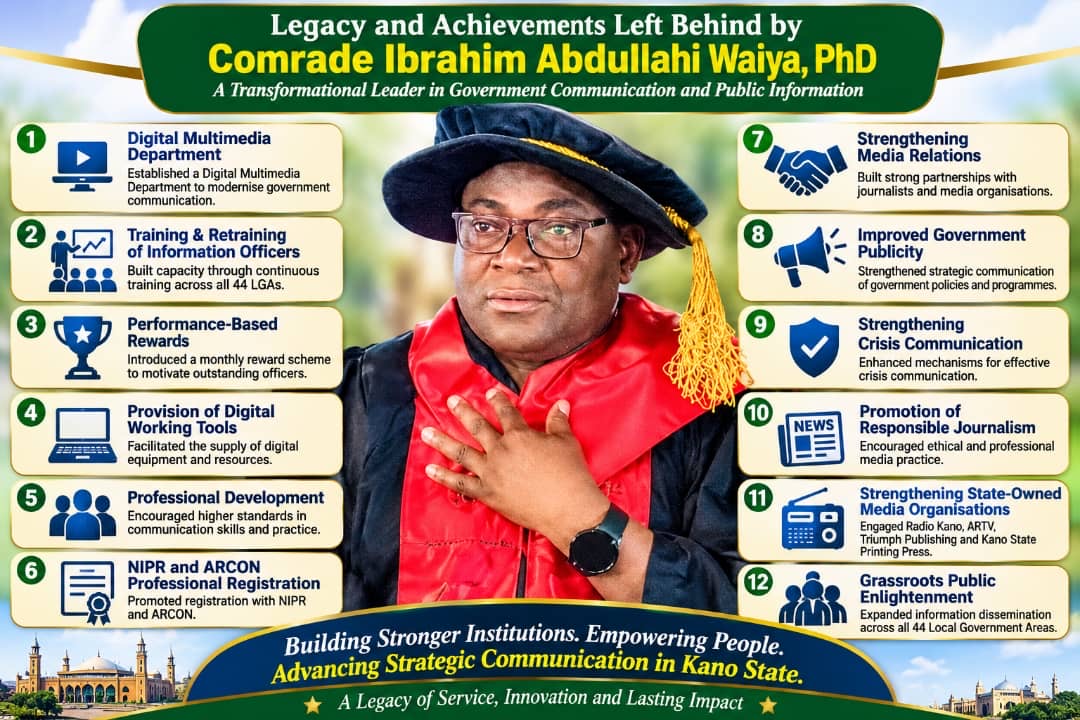
One of the notable aspects of his administration was the emphasis on institutional modernisation and the adoption of contemporary communication technologies. The initiative to establish a Digital Multimedia Department represented an important step towards repositioning government information management in an increasingly technology-driven environment. This direction was complemented by efforts to provide digital working equipment and resources, encourage multimedia production and improve the use of online platforms in communicating government policies, programmes and activities.
Equally significant was his commitment to human capital development, particularly among Information Officers serving across Kano State’s 44 Local Government Areas. Recognising that an effective information management system depends largely on the competence of its workforce, he encouraged continuous training, retraining and professional development. His administration also introduced a monthly performance-based reward initiative to recognise outstanding contributions, while promoting higher professional standards through initiatives supporting registration with relevant bodies, including the Nigerian Institute of Public Relations (NIPR) and the Advertising Regulatory Council of Nigeria (ARCON).
Another important dimension of his contributions was the strengthening of strategic communication and government-media relations. Through sustained engagements with journalists, media executives, professional associations and media organisations, he promoted constructive relationships between government institutions and the media. His approach also emphasised responsible journalism, accuracy, ethical reporting and professionalism. These engagements were complemented by efforts to improve government publicity, coordinate information across Ministries, Departments and Agencies, and enhance the visibility of public policies and programmes through radio, publications and digital communication channels.
His attention to crisis communication and public information management further demonstrated the importance he attached to responsible government communication. By promoting improved approaches to handling sensitive public issues, he encouraged more coordinated and effective responses to situations requiring timely, accurate and credible information. His engagement with state-owned media institutions, including Radio Kano, ARTV, Triumph Publishing Company and Kano State Printing Press, also reflected an understanding that these organisations remain important instruments for public enlightenment and the dissemination of government information.
At the grassroots level, efforts to strengthen information dissemination structures across the 44 Local Government Areas demonstrated the importance attached to ensuring that government information reaches communities beyond the state capital. The development of these structures, alongside the provision of digital tools and operational resources, was directed towards improving the effectiveness of local information personnel. Collectively, these interventions reflected an administrative philosophy that recognises communication not merely as a publicity function, but as an essential instrument of governance, public engagement and institutional accountability.
Ultimately, the significance of Dr Ibrahim Abdullahi Waiya’s contributions lies in the broader institutional direction they sought to establish: a more professional, technologically responsive, coordinated and people-oriented public communication system. While individual initiatives may be associated with a particular administration, their enduring value rests on the extent to which the structures, standards and professional culture they promote continue to serve the state. His legacy, therefore, deserves to be examined not only through the activities undertaken during his tenure, but also through the institutional foundations and professional capacity developed within Kano State’s information sector.
By Munir I. Publisher
“`Kano State Coordinator RHGM and Director Contact and Mobilisation NYA Kano State.“`