

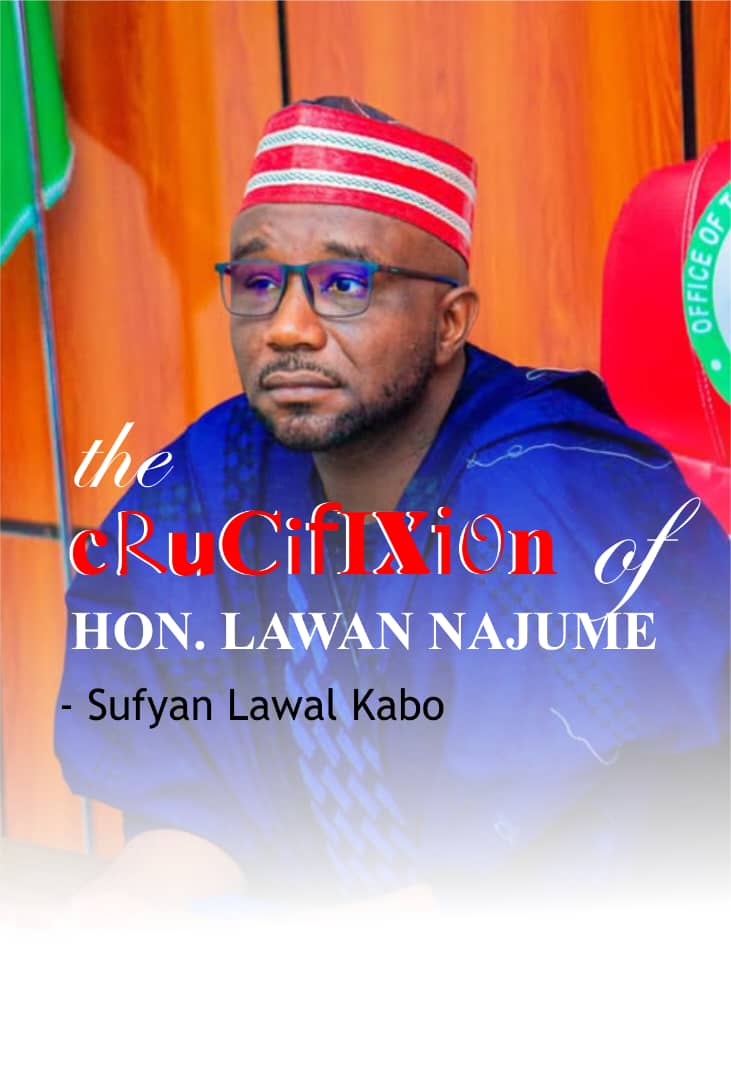
Politics, Perception and the Reality of Grassroots Governance
By Sufyan Lawal Kabo
Public office has never been a comfortable place to occupy. The higher a leader rises, the louder the applause from supporters and the harsher the criticism from opponents. That is the nature of democracy. Every decision is scrutinised, every action interpreted differently, and every achievement viewed through political lenses.
A few months ago, I published an article highlighting the leadership style and grassroots impact of Hon. Lawan Najume, the Executive Chairman of Kabo Local Government Area. I never imagined the reactions it would generate. The article travelled beyond Kabo to readers across Nigeria and even members of the Kabo diaspora. My phone rang endlessly. WhatsApp messages, voice notes and emails followed. While many appreciated the piece, others dismissed it as politically biased.
The dominant criticism was that Hon. Lawan Najume had focused more on empowering individuals than on constructing visible infrastructure. According to his critics, distributing vehicles, motorcycles and financial assistance to young people could never substitute for roads, drainage systems or public buildings.
Ordinarily, social media debates fade with time. I thought this one had ended until several months later when I received a WhatsApp call from Abuja. The caller, a senior civil servant in one of the Federal Government ministries, challenged almost every argument I had made. Our conversation lasted for hours.
The turning point came when I told him, “If I were Hon. Lawan Najume, I would probably make many of the same choices.”
Surprised, he asked, “Are you saying he is doing the right thing?”
My answer was simple.
“Leadership should first be judged by the problems it chooses to solve before it is judged by the projects people can easily photograph.”
That statement became the foundation of our discussion.
The truth is that democracy is not a rigid formula. It is government that responds to the peculiar needs of its people. What qualifies as a priority in one community may not necessarily be the priority in another. A local government battling unemployment cannot adopt exactly the same development strategy as one whose greatest challenge is erosion, flooding or insecurity. Development is therefore contextual, not mechanical.
For decades, Kabo, like many communities across Kano North, has faced one persistent challenge: youth unemployment. Thousands of energetic young men possess the willingness to work but lack the capital to begin. Others have acquired skills but cannot afford the tools required to earn a living. Under such circumstances, any responsible leader must ask a fundamental question: What intervention will create the quickest and most sustainable economic impact?
This is where many critics misunderstand Hon. Lawan Najume’s philosophy of governance.
Youth empowerment should never be dismissed as mere charity or political patronage. Across the world, governments increasingly recognise that economic growth depends not only on physical infrastructure but also on investing in people. Countries that transformed their economies over the past few decades did so by encouraging entrepreneurship, supporting small businesses and equipping citizens with productive assets. Buildings alone do not eliminate poverty; productive citizens do.
Viewed from this perspective, the distribution of vehicles and motorcycles assumes a different meaning. These are not simply gifts; they are productive assets. A motorcycle can provide daily income through commercial transport. A vehicle can become a business tool. Some beneficiaries may even choose to sell such assets and invest the proceeds in shops, agriculture or other enterprises better suited to their aspirations. Whatever choice they make, the objective remains the same: creating economic independence rather than prolonged dependence.
This does not mean infrastructure should be neglected. Roads, schools, healthcare facilities and markets remain indispensable to development. However, governance is ultimately about setting priorities within limited resources. A local government chairman must constantly decide which intervention will produce the greatest benefit at a given time. Reasonable people may disagree with those choices, but disagreement alone should not be mistaken for failure.
Beyond empowerment, Hon. Lawan Najume’s administration has supported education, health, agriculture, road constructions, community sanitation and many other grassroots initiatives aimed at improving the welfare of residents. These efforts reflect an understanding that development is not measured only by concrete structures but also by investments in human capital and social wellbeing.
Another criticism frequently directed at the Chairman is that he no longer answers telephone calls as freely as he once did. While public officials should remain accessible, this complaint also deserves context. Before assuming office, a politician may receive a few calls each day. Once elected, those calls often multiply into hundreds, many involving requests for financial assistance, employment or personal favours. No leader can personally respond to every call while simultaneously managing the responsibilities of government..
The communicative value, media reach, and strategic alignment brought by influential cultural figures to broader state and national campaign projects easily justify these conventional political investments.
That is precisely why public institutions operate through protocols, appointments and official channels. These procedures are not designed to distance leaders from the people; they exist to ensure that governance remains organised. In reality, many public office holders eventually abandon their personal telephone numbers altogether because the volume of calls becomes overwhelming. If Hon. Lawan Najume still maintains his known contact lines, even if he cannot answer every call, that reality should be appreciated rather than automatically interpreted as arrogance.
Inevitably, intense political relevance breeds malicious speculation. Critics recently circulated rumors alleging that the Chairman funded a business setup for a popular female TikTok star, Shafaatu Ahmed (Londonbe). This claim is a baseless fabrication designed to distract from his tangible impacts.
Similarly, political detractors have pointed to the strategic gift of a vehicle to the prominent political musician, Dauda Kahutu Rarara. Whether that assertion is true or false, it should be noted that within the framework of Nigerian political communication, such gestures are neither anomalous nor wasteful. High-profile public relations and strategic media campaigns are fundamental to political mobilization for candidates at all levels ranging from the Chairman himself, his governor or even the President of a nation.
Politics, unfortunately, also creates room for rumours and speculation. Every prominent public figure eventually becomes the subject of stories, accusations and assumptions, particularly in the age of social media. While public officials should always be held accountable, fairness demands that criticism be based on verifiable facts rather than unsubstantiated claims or political sentiment.
Ultimately, this article is not an attempt to suggest that Hon. Lawan Najume is beyond criticism. No public servant is. Neither is it an argument that every decision of his administration has been flawless. Rather, it is an appeal for a more balanced standard of judgment.
Too often, we measure development only by the number of buildings constructed or roads commissioned. Yet some of the most meaningful investments cannot always be captured in photographs. A young man who moves from unemployment to self-reliance may never appear on the front pages of newspapers, but his transformation can change the future of an entire family.
History teaches us that societies progress not only through physical infrastructure but also through the empowerment of their people. If leadership is ultimately measured by the number of lives positively influenced, then any honest assessment of Hon. Lawan Najume should consider not only what has been built but also what opportunities have been created.
Perhaps that is where the debate should begin, not with political prejudice or emotional arguments, but with a sincere examination of whether his policies have expanded hope, reduced economic hardship and created opportunities for the people of Kabo. On that question, every fair-minded observer deserves to look beyond the noise before passing judgment.
Sufyan writes from Kano