

By Munir I. Publisher
At a time when rising transportation costs continue to place enormous pressure on millions of Nigerians, particularly following the removal of fuel subsidy, the recent launch of the Northern Region Compressed Natural Gas (CNG) and Electric Vehicle (EV) initiative in Kano represents more than a ceremonial government programme. It signals the beginning of what could become one of the most significant economic and industrial transitions in Northern Nigeria in recent decades.
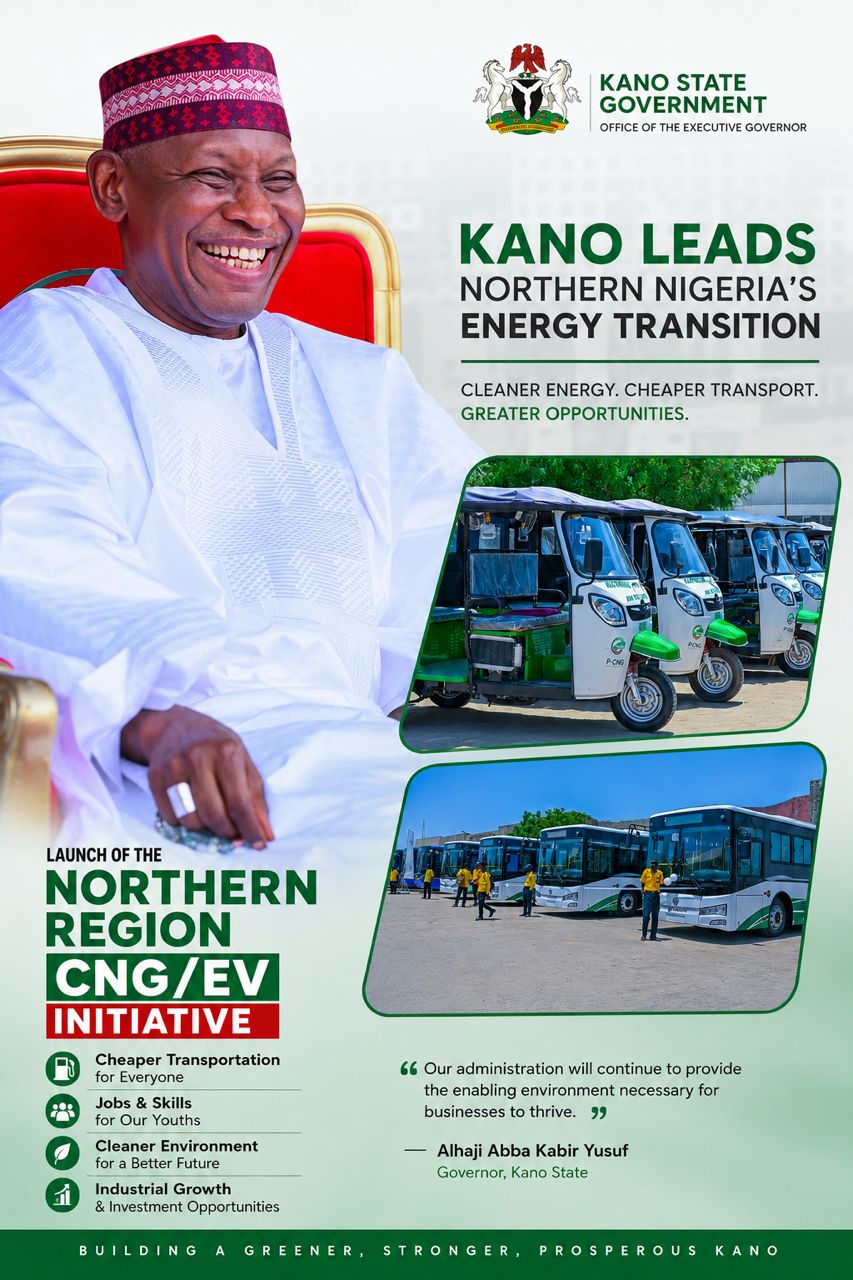
The official activation of the initiative by Kano State Governor, Alhaji Abba Kabir Yusuf, alongside representatives of the Federal Government and the Presidential Initiative on CNG and Electric Vehicles (Pi-CNG & EV), has positioned Kano as a potential regional hub for alternative energy development. More importantly, it has opened a national conversation about how Nigeria can gradually move away from dependence on expensive petroleum products toward cheaper and more sustainable energy alternatives.
For many Nigerians, the removal of fuel subsidy brought severe economic consequences. Transportation fares skyrocketed, the cost of goods increased sharply, and small businesses struggled to survive under rising operational expenses. In Northern Nigeria, where transportation remains one of the most critical components of commercial and social activity, the impact has been particularly severe. Commercial drivers, traders, students, and ordinary citizens have all faced the burden of escalating fuel costs.
It is within this difficult economic context that the CNG initiative becomes highly significant.
Compressed Natural Gas is considerably cheaper than Premium Motor Spirit (PMS), making it a practical alternative capable of reducing transportation costs for both commercial operators and private vehicle owners. Beyond affordability, CNG also presents long-term environmental and economic benefits, especially for a developing economy seeking sustainable industrial growth.
What makes the Kano activation especially important is not merely the launch itself, but the strategic vision behind it. Governor Yusuf’s administration appears to understand that economic recovery cannot rely solely on traditional governance models. Instead, modern states must position themselves to attract investment, encourage innovation, and create opportunities within emerging industries.
The governor’s emphasis on conversion centers, refuelling infrastructure, assembly plants, technical services, and manufacturing demonstrates an understanding that the energy transition is not only about fuel substitution; it is also about economic diversification and industrial expansion.
Perhaps one of the most promising aspects of the initiative is its potential impact on youth employment. Kano possesses one of the largest youth populations in Nigeria, with thousands of young people seeking meaningful economic opportunities. The development of a CNG ecosystem could create jobs for technicians, engineers, conversion specialists, logistics operators, welders, mechanics, and entrepreneurs across multiple sectors.
The governor’s revelation that youths have already begun receiving training in vehicle conversion and technical maintenance indicates that the state may be preparing not just for immediate implementation, but for long-term sustainability. This proactive approach is critical because infrastructure projects often fail when governments neglect the human capacity required to sustain them.
Equally important is the broader regional implication of the initiative. During the event, Senator Hassan Hadejia, Deputy Chief of Staff to the Vice President, observed that Northern Nigeria possesses one of the largest transportation fleets in West Africa. This observation is not an exaggeration. The North serves as a major commercial corridor connecting several Nigerian states and neighbouring countries through extensive transportation networks.
If properly implemented, the widespread adoption of CNG could significantly reduce transportation expenses across regional markets, potentially lowering the prices of goods and services while stimulating interstate commerce. In effect, Kano could emerge not only as a political and commercial center, but also as a strategic energy and transportation hub for the entire region.
Another notable dimension of the initiative is the growing cooperation between federal and state authorities. In a political environment often characterized by rivalry and division, the collaboration between the Kano State Government and the Federal Government on this project presents a refreshing example of governance driven by practical economic interests rather than partisan considerations.
Development initiatives of this magnitude require cooperation, continuity, and strategic coordination. Investors are more likely to commit resources where governments demonstrate stability, seriousness, and a willingness to provide an enabling environment for businesses to thrive.
The commissioning of the Asad CNG and Greenville LNG stations along the Kano-Zaria Road further suggests that the initiative is moving beyond policy declarations into visible implementation. For many Nigerians, confidence in public projects is built not on speeches, but on physical infrastructure and measurable outcomes.
However, while the initiative deserves commendation, its long-term success will depend heavily on consistency, accessibility, and public confidence. The government must ensure that conversion costs remain affordable, safety standards are maintained, and refuelling infrastructure expands beyond major urban centers into wider communities. Public sensitization will also be essential to encourage adoption among vehicle owners who may still be unfamiliar with CNG technology.
Additionally, policymakers must avoid allowing the initiative to become another short-lived political programme abandoned after initial publicity. Sustainable development requires continuity beyond political cycles.
Nevertheless, the launch of the Northern Region CNG and EV initiative in Kano represents a bold and timely step in the right direction. At a moment when Nigerians are searching for practical economic relief, the project offers a glimpse into how innovation, infrastructure, and strategic leadership can combine to address some of the country’s most pressing challenges.
If properly sustained, Kano’s alternative energy drive may eventually be remembered not simply as a government programme, but as the foundation of a broader economic transformation capable of reshaping transportation, industrial development, and energy consumption across Northern Nigeria.
In many ways, the journey toward Northern Nigeria’s energy transition may have just begun.